
Stop Telling AI How
Tell it what you want to happen. Let it figure out how to get there.

Here’s a recommendation I got back from an AI recently. Take a look:
Write about a belief you’ve publicly held about remote work — and explain why you’ve changed your mind. Readers don’t reply to question posts. They reply when they want to update their mental model of you.
What kind of prompt do you think produced that?
Not write me a controversial post. Or write me a vulnerable personal story.
Just: My goal for my next newsletter post is to get more replies than usual. My topic is remote work. My readers are [who they are]. What would you suggest?
I didn’t give it a format or guide it specifically into one. I let it offer me an idea.

What a method word does in a prompt
When you type write me a listicle or write me a controversial take, you’ve made a creative decision before AI had a chance to weigh in.
The method sort of takes over the prompt.
What comes back is exactly what you asked for.
You end up with the thing you could already picture. The things you couldn’t picture never come up.
Which is fine if that’s what you’re after.
In this guide I want to show that even if you have something in mind this technique can give you new ideas to try.
Instead of writing prompts like these:
Prompt 1: Write me a question post about remote work that invites readers to share their experience.
Prompt 2: Write me a controversial take arguing that remote work is actually harder than going into an office.
Each one produces what it promises. A question at the end or a thesis people can push back on. These are fine, but every option was already in your head before you typed.
Try a prompt like this:
My newsletter is about [TOPIC]. My readers are [WHO THEY ARE].
My goal for my next post is to get more replies than usual.
Tell me three approaches that tend to get readers to respond, and explain why each one works.
Replace [TOPIC] and [WHO THEY ARE] with your actual details.
Two of the three options might be familiar. The question post or the controversial take. But there’s usually one that sparks an idea for you.
That’s worth looking at. Even if you don’t use it as-is, you might come up with a new spin on what you already had in mind.
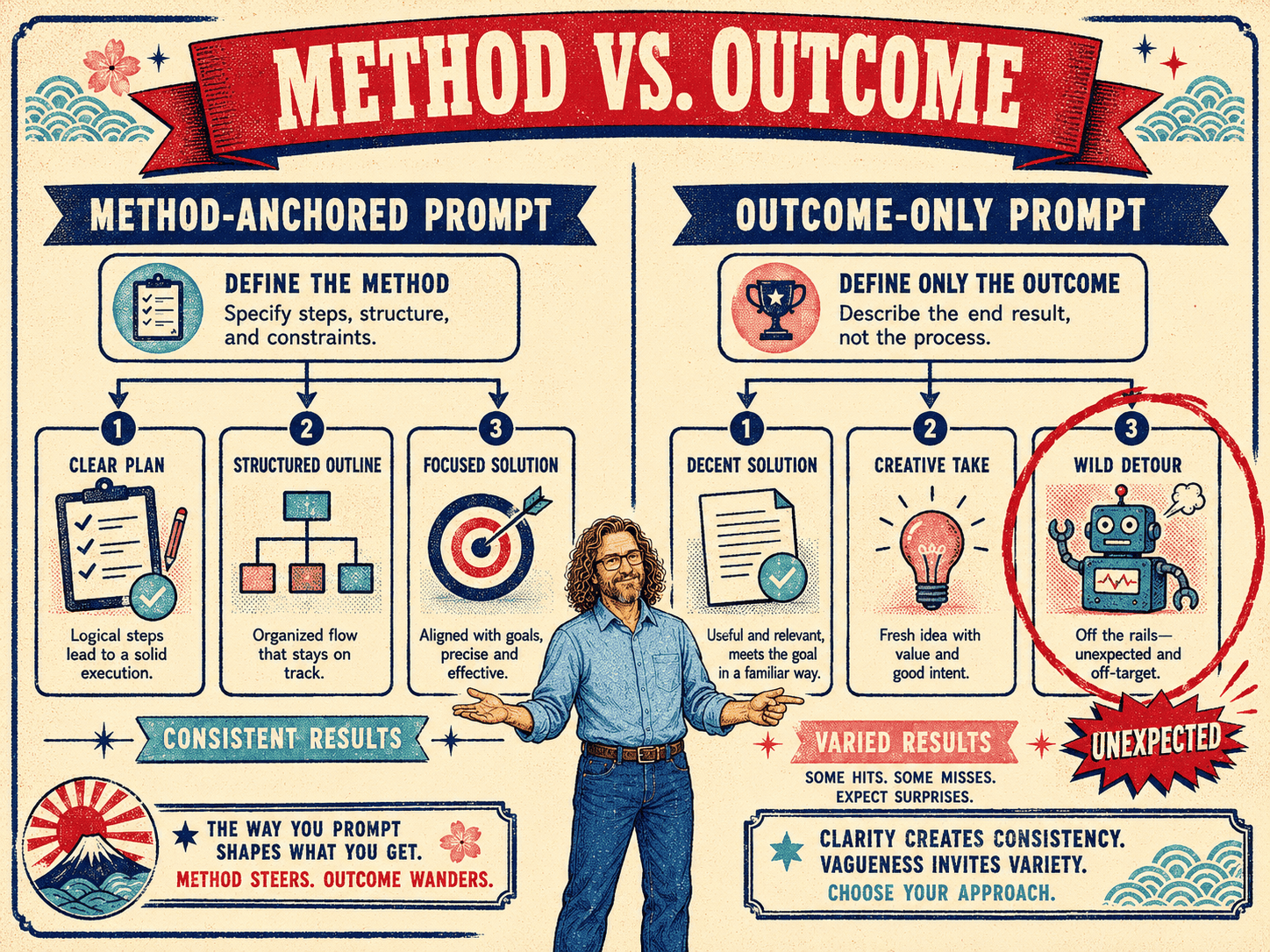
Separating the goal from the method
Stating what you want to accomplish without telling AI how to accomplish it. When you leave the method out, AI can suggest one you hadn’t pictured.
The Method Releaser
This prompt spark strips the method out of any prompt you’re about to send.
Copy this into your favorite AI tool:
Here’s a prompt I’m about to send: [YOUR PROMPT]
Find any places where I’ve stated or implied a specific method, format,
or approach. Rewrite the prompt to describe what I want to accomplish
without specifying how. If you remove a method word, note it so I can
see what changed.
Replace [YOUR PROMPT] with whatever you were about to type.
Again, you don’t have to use this newly rewritten prompt. But it may give you ideas. That’s all I want you to take away from this guide.
The curiosity to try things in the AI era is a skill itself.
Let’s recap
Every time you write write me a [format], you’ve made a creative decision before AI had any input.
That decision isn’t wrong but it limits what you get back to what you could already imagine.
State the outcome. Skip the method. Let AI suggest an approach outside your usual vocabulary.
Give it a try on something you’re working on. Tag me, I’d love to see what comes back that surprised you.
Below, I’m sharing the Method/Outcome Swap Library: 34 “Stop saying X / Start saying Y” prompt pairs organized by task type. Skim it once and you’ll catch the old habit in no time.
