
One Cupcake Changed Everything
When someone says "use concrete language" what does that even mean?

Someone ever tell you to use “concrete language” when you write?
What does that even mean?
I found a neat way to explain it. In this post I will:
Take you through a short experiment.
Make it crystal clear what “concrete” means
Show how you can use it with AI
Stop! I challenge you not to peek at the image below.
Until you read this story first. It’s only 100 words.
Let me frame it for you.
This is a story about Japanese Summer Matsuri (festivals).
Read it slowly. Form a picture in your mind as you read it.
Lanterns sway. Red, gold, paper globes glow above wooden stalls. Children run, yukata fluttering, wooden geta clacking on stone. A man pounds a taiko drum. Boom. Boom.
Steam curls from grilled squid, yakitori, takoyaki balls. A girl scoops a goldfish with a paper net. It breaks. She laughs. Cicadas scream from pine trees. Smoke rises from charcoal.
An old woman fans herself, sipping cold barley tea. Fireworks bloom above the river, painting faces blue, pink, green. A boy bites a candied apple. Juice drips.
Couples cross a wooden bridge, hands linked. Moths circle the lanterns. The drum pounds again.
Okay, now you’re ready to see the image.

It won’t match what you imagined as you read the story. But look at how packed the scene is with everything from the story. The little girl laughing, the boy and the candied apple… there is so much detail.
Your experiences conjure imagery from the words. The concrete words. Let me give you a definition.
Concrete Words: Physical objects, actions, or phenomena that exist in the real world and can be observed, touched, measured, or experienced.
If you re-read the story you’ll notice it’s STUFFED with concrete words, like: lanterns, children, fluttering, steam… fireworks, cicadas, candied apple… all words our brains instantly visualize.
This has a powerful impact on memory.
Turns out our brains store words like this twice. Once as the word, and once as the image.
This is why concrete language powers the best stories we remember.
And why it is so effective in AI. These words pack in a lot of context.
Lets learn by doing shall we? Give this a try.
Let me show you how I created the story and image so you can do this too.
Here’s the prompt I used. Copy it into your favorite AI tool (I used Claude, w/Opus 4.7).
Write a 100 word short story about [YOUR TOPIC] using only words that can be visualized. Like the word “chicken” vs a word like “really.”
Replace [YOUR TOPIC] with whatever you wish the story to be about. The goal is a story packed with concrete language like my example story.
Then here’s what I used in ChatGPT (their new images 2.0 model is fantastic).
Create an image for this short story:
[PUT YOUR STORY HERE]
Choose a style that fits the story theme and vibe, with nostalgia.
That last line… change it to express any specific styles you want. I kept it simple.
When you try this, tag me. I’d love to read your stories and see the images they create.
What if we took it a step further?
What if we provide specific details, places, or people in the prompt? We can turn it into a 2-step way to create incredible newsletter visuals!
To keep it simple we can let AI study one of our articles.
Here’s the prompt:
Read this article: [YOUR ARTICLE URL] — then write a 100 word short story capturing the core message using only words that can be visualized. Like the word “chicken” vs a word like “really.”
And then in the image prompt we add more style and aesthetic instructions.
I did this for an article I co-authored with Pinkie from AI Meets Girlboss.

The story created was:
A baker placed one cupcake in her window. People walked past, glanced, kept walking. The next morning, she set out a mirror beside a tray of frosting, sprinkles, candles, paper crowns. A girl stopped. She frosted a cupcake, pressed a candle into it, lifted the crown onto her own head, snapped a photo. A boy followed. Then a woman in red boots. Then a grandfather, a postman, twins in matching coats. Each one walked out holding a cupcake with their face beside it. By sunset, the window held a hundred photographs. The street smelled like sugar. The baker smiled.
Then I added my brand aesthetics and ended up with this:
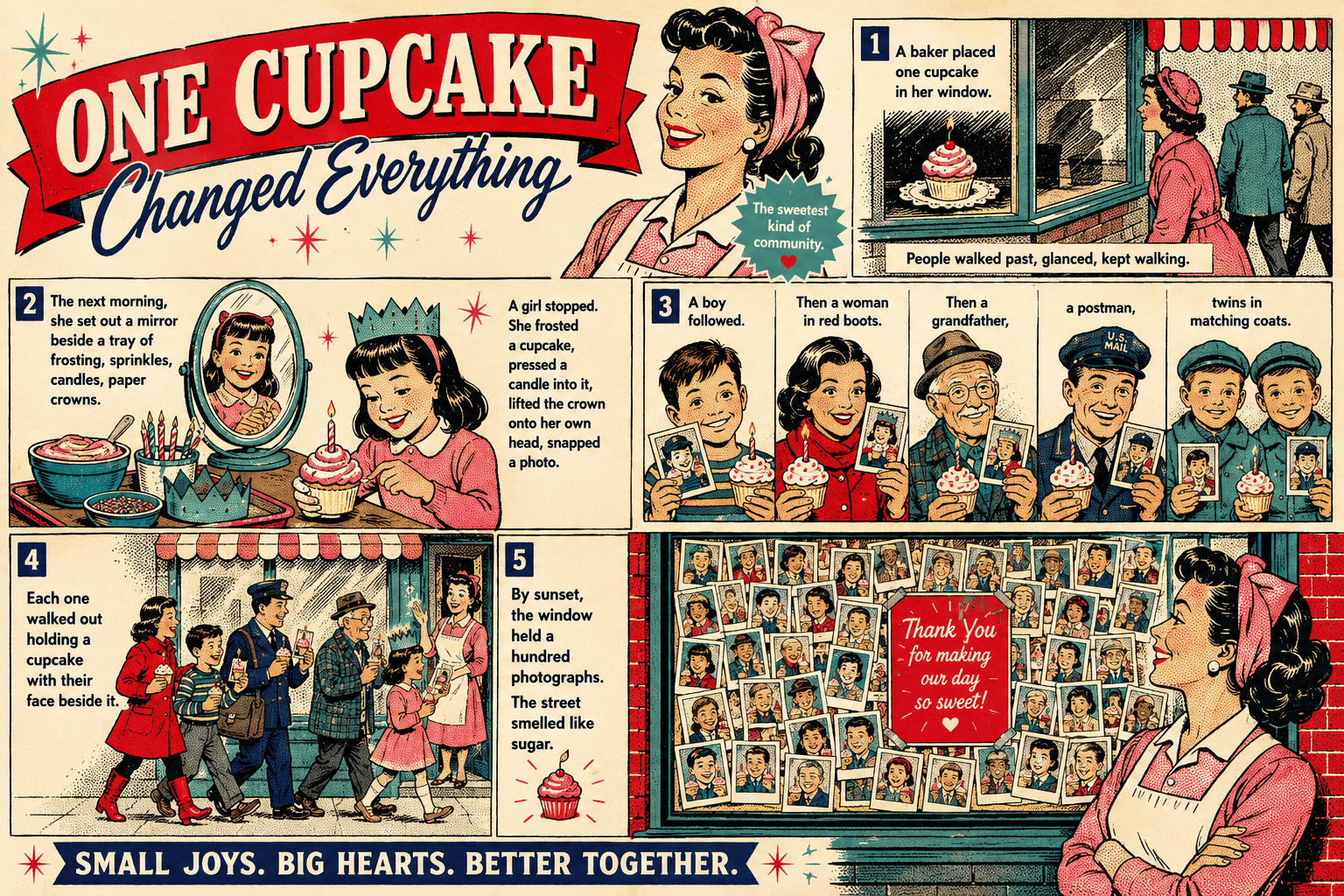
I think it nails the core message. That building a fun way for readers to participate creates a community and fosters great relationships. That we can make the world a better place in our own tiny ways.
Now it’s your turn.
Let’s recap:
Concrete words are the words representing what you can visualize.
Use AI to craft a story packed with vivid concrete words about your topic.
Then use the story + brand aesthetics to create rich imagery for your work.
Give it a shot. Tag me with your results. I’d love to see how this works out for you. While I cook up some more recipes you can add to your cookbook.
P.S. I call this a prompt spark.
A prompt spark is meant to “spark” creative use of AI. Not every prompt spark will be a teaching moment like this one (about concrete language). But I aim to give you something that makes you go “oh cool! I never thought to try this before!”
I hope I succeeded.
Really fascinating read, thanks for sharing!
Thanks for this great article Chad. I absolutely love the idea of a prompt spark, and concrete words are such a powerful way to both 'tame the AI' and also convey information to multiple audiences. I guess this is also why concrete poetry is so effective!